Mattancherry Palace — a modest repository of India’s ancient treasures
At first glance the structure with the pompous name «Mattancherry Palace» may disappoint: the building resembles a medieval warehouse more than a luxurious exotic mansion. But behind the deceptive simplicity the main thing is hidden — the palace’s treasures are kept inside. These are unique wall murals, portraits of the rulers of Kochi, a rich collection of weapons and objects of royal everyday life. Even a continuous stream of visitors does not prevent one from appreciating the artistic value of the exhibits.
The Dutch Palace of Portuguese construction
In the south of India, in the state of Kerala, famous for its beaches and Ayurvedic clinics, lies the large port city of Kochi (Cochin) — one of the oldest centres of the spice trade. It is here that the Mattancherry Palace is located, built around 1545.
In 1502 the celebrated Portuguese navigator Vasco da Gama founded in Cochin the first European factory in India — a trading settlement of Europeans in a colonial country. Later, to protect the merchants and goods, a military fort was erected here.
Although the palace was built by the Portuguese, it is often called the Dutch Palace. The point is that more than a hundred years after its construction, in 1663, the Dutch seized this territory. They thoroughly renovated the building, without, however, changing either its style or its layout.
Mattancherry Palace — photos of the attraction
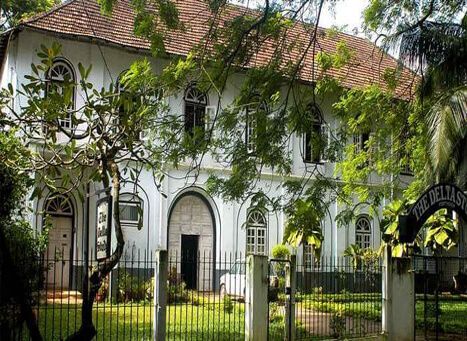
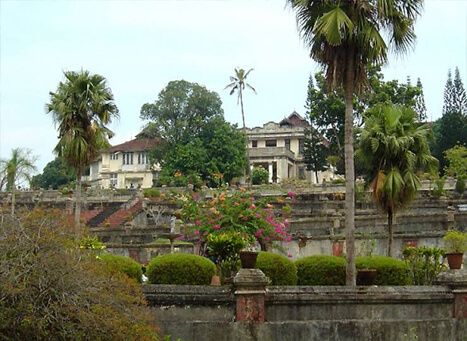
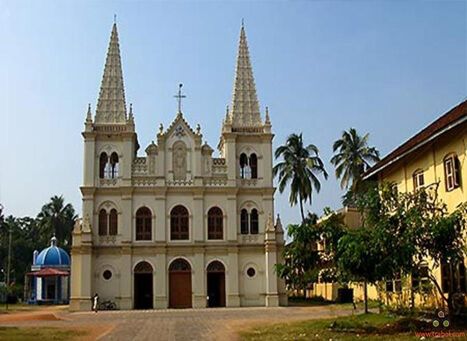

A palace, a warehouse, a fort or a sanctuary?
The appearance of the building really does not live up to its pompous name: it is rather a practical medieval structure for warehouses and offices than a palace. The area cleared of trees, the high-set windows and doors, the wrought-iron grilles in the window openings — all these were necessary security measures of those times, protection against attacks.
The large quadrangular structure with an inner courtyard became a gift from the Portuguese to the royal dynasty of the rulers of Kochi. In the centre of the spacious courtyard stands a temple of a Hindu goddess — the patroness of the royal family of Kochi. On the palace grounds there are two more temples, dedicated to Shiva and Krishna. Part of the building is given over to a functioning Hindu temple, to which tourists have no access.
The treasures of the Dutch Palace
The Mattancherry Palace is famous for its collection of beautiful frescoes depicting Hindu gods, scenes from the epics «Mahabharata» and «Ramayana», as well as subjects from the works of the celebrated poet Kalidasa. The colourful, skilfully executed murals occupy almost 300 square metres of walls. As one moves deeper into the building, whole epic stories about the life of gods and ancient rulers unfold before the viewer.
Eyewitnesses tell of unusual images: the eyes of the painted figures seem to watch the visitors passing by, and the toes of the footwear on a fresco seem to shift slightly depending on the point of view.
Among the museum’s exhibits are life-size portraits of the rulers of Kochi, ceremonial ornaments and weapons, coins and maps of the colonial period. Of particular interest is the royal bedchamber, preserved almost unchanged: its walls and ceiling are covered with dozens of colourful frescoes illustrating the «Ramayana» — the tale of the wanderings of Rama, the legendary ruler of ancient India. For centuries this text has been revered as one of the sacred texts in Hinduism.
Information for tourists
The Mattancherry Palace is part of many popular tourist routes, and school excursions often come here, so the place is crowded and noisy. The steep and high entrance staircase is not adapted for people with disabilities. The museum is open from 10:00 to 17:00; the day off is Friday.
Kochi is the gateway to Kerala, where they offer Ayurvedic programmes in Kerala: a visit to the palace can be combined with wellness.
Hotels located near the Mattancherry Palace