Kuti Praveshika: Ayurvedic rejuvenation in seclusion and darkness
Kuti Praveshika is one of the rarest practices in Ayurveda: a restorative course undertaken in complete darkness, in a secluded hut, cut off from sunlight, wind and sound. It is the most extreme, “reclusive” form of rasayana — the Ayurvedic tradition of rejuvenation and restoring one's strength. By various accounts, there are only a handful of such huts in India, and it is undertaken under constant medical supervision.
What Kuti Praveshika is
“Kuti Praveshika” translated from Sanskrit means “entering the hut”. The name describes the essence literally: for the duration of the course a person retreats into a specially arranged space (kuti) and stays there in seclusion and darkness, taking Ayurvedic herbal preparations on a strict regimen.
Rasayana in Ayurveda comes in two forms (more on the rasayana page):
- vatatapika — the “outpatient” one: the restorative course is done without dropping out of everyday life;
- kutipraveshika — the “reclusive” one: complete seclusion in a closed hut. It is considered the deepest and the most demanding form.
A related concept is kayakalpa: this is the name for practices of deep rejuvenation and the extension of an active life; Kuti Praveshika is counted in the same family.
The hut and the darkness: how it all works
The main feature is the environment. The kuti is built with three layers, following the principles of vastu, and inside it maintains complete darkness: minimal light (a candle) is allowed only during meals. The room is cut off from the sun, the wind and, as far as possible, from outside sound. In the tradition such a hut is compared to a womb — in the sense of a protected space where a person “is restored anew”.
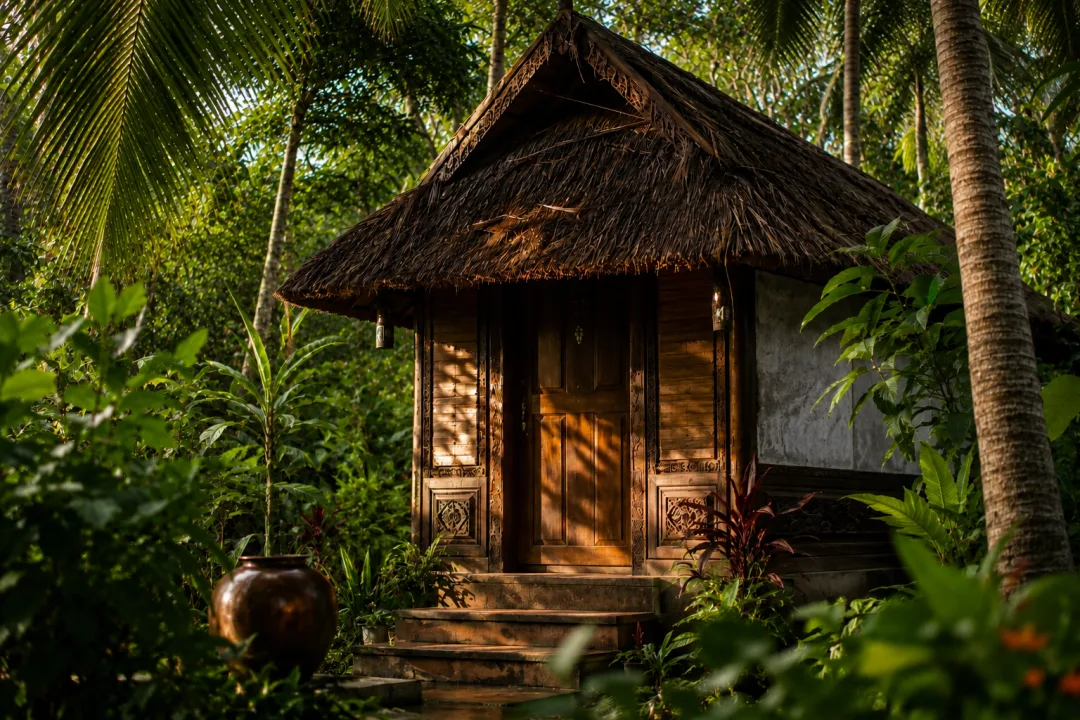
Inside it is extremely simple and without prescribed rituals:
- no devices and no outside stimuli; the person neither sees nor talks to others;
- what to do is up to the person: meditation, rest, reflection — whatever feels comfortable; there is no rigid programme of “what to do”;
- herbal compositions (rasayana) and Ayurvedic preparations — as prescribed by the doctor;
- daily monitoring: the doctor comes to check on the person's condition, and a separate attendant brings everything needed for daily life.
By the logic of the tradition, it is precisely silence, darkness and the absence of outside stimuli that allow body and mind to recover more deeply than in the usual rhythm.
How long it lasts and how you prepare
- Duration: a minimum of 14 days, optimally about 4 weeks. This is an immersion lasting weeks, not a one-off procedure.
- Preparation: the course must be preceded by Panchakarma — a minimum of about three weeks. Kuti Praveshika itself is not a cleansing (unlike panchakarma) but the restorative stage after it: first the body is cleansed, then it is restored.
- The start dates are traditionally chosen partly according to the astrological calendar — a favourable time is considered important for going through the course calmly.
Who it suits — and who it doesn't (honestly)
Kuti Praveshika is traditionally considered for those who have already gone through panchakarma, practise yoga or are ready for vipassana-type retreats. Illness is not a requirement — healthy people also turn to the practice, seeking deep restoration.
But it is a physically and emotionally demanding experience, and it does not suit everyone. Clinics select participants by application and the doctor's decision, and there is a direct contraindication: the practice is not recommended for people with mental instability or a tendency towards self-harm. It calls for discipline, readiness for solitude and a stable mental state.
The decision to take part is always made by the clinic's doctor. And if you have chronic conditions, such a course is done in addition to your own doctor's supervision, not instead of it.
How it differs from panchakarma, vipassana and meditation
- From Panchakarma — in that it is not a cleansing but seclusion in darkness (panchakarma is done beforehand, as preparation);
- from vipassana — in that here the person does not see or communicate with others at all;
- from ordinary meditation retreats — in that the person is left alone with themselves, without a facilitator and without a set programme.
Where to do it
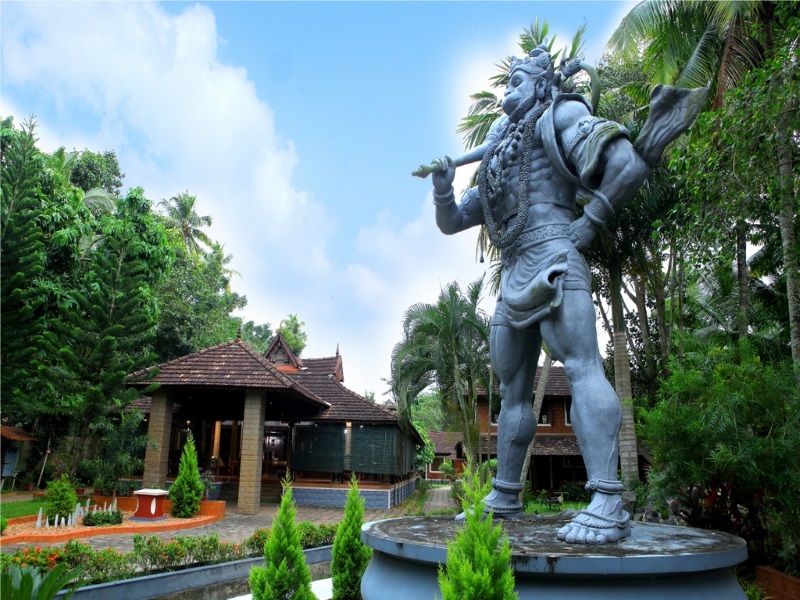
Kuti Praveshika is offered by only a handful of clinics — according to official data, there are just three such huts in India. One of them is the clinic Athreya (Athreya Ayurvedic Centre) in Kottayam, Kerala: there the programme is run by doctors of the traditional rasayana lineage, individually and for a small number of guests per season.
Kerala is the classic destination for deep Ayurvedic courses: the humid tropical climate is traditionally considered favourable for restorative practices (more on this — Ayurveda in Kerala). Specialised organisers can help you choose a programme and arrange the trip — see Ayurvedic tours and clinic catalogue. This removes the main difficulty of an independent trip — the choice of a proven clinic and the understanding of what exactly will suit you.
Conclusion
Kuti Praveshika is the rarest and deepest form of rasayana: weeks in darkness and seclusion, under a doctor's supervision, after a preparatory panchakarma. It is a demanding practice approached consciously and by the doctor's decision — and perhaps the most unusual thing the Ayurvedic tradition of restoration has to offer.
You can do Kuti Praveshika at the following clinic in India
Frequently asked questions
From Sanskrit it means “entering the hut”. This is the name for the reclusive form of rasayana: a course of Ayurvedic restoration undertaken in a secluded dark hut, on a strict regimen and under a doctor's supervision.
Yes. The hut is kept in complete darkness; minimal light (a candle) is allowed only during meals. The room is cut off from sunlight, wind and, as far as possible, from sound — that is the very essence of the practice.
A minimum of 14 days, optimally about four weeks. The course must be preceded by panchakarma (about three weeks) as a preparatory stage.
Panchakarma is a cleansing, and it is done beforehand, as preparation. Kuti Praveshika is restoration in darkness and seclusion. It differs from vipassana and meditation retreats in that the person neither sees nor speaks with others and stays alone with themselves, without a guide.
These are closely related concepts from the same family of deep rejuvenation and restoration practices. Kuti Praveshika is counted among kayakalpa — the “art of longevity” in the Ayurvedic tradition.
It is a physically and emotionally demanding experience. It is not recommended for people with mental instability or a tendency towards self-harm; it calls for discipline, readiness for solitude and a stable mental state. Participants are selected by application and the doctor's decision.
The programme is run by only a handful of clinics in Kerala. Among ours is the Athreya Ayurvedic Centre in Kottayam — individually and for a small number of guests.
Ready to discuss a Kuti Praveshika course? We will select a programme and a clinic to match your goal.