
Ayurveda · India
Body cleansing according to Ayurveda in clinics in India
In Ayurveda, body cleansing is not fasting and not «detox for weight loss», but a programme for restoring digestion and metabolism. Its task is to remove accumulated toxins (ama), bring the doshas back into balance and support the natural working of the excretory systems. The course takes place under a doctor’s supervision: diagnosis, preparation, cleansing procedures and recovery. We will find a clinic and a programme to match your condition.
Find a clinic Read client reviews →
since 2015
year
1,000+
clients
50+
clinics
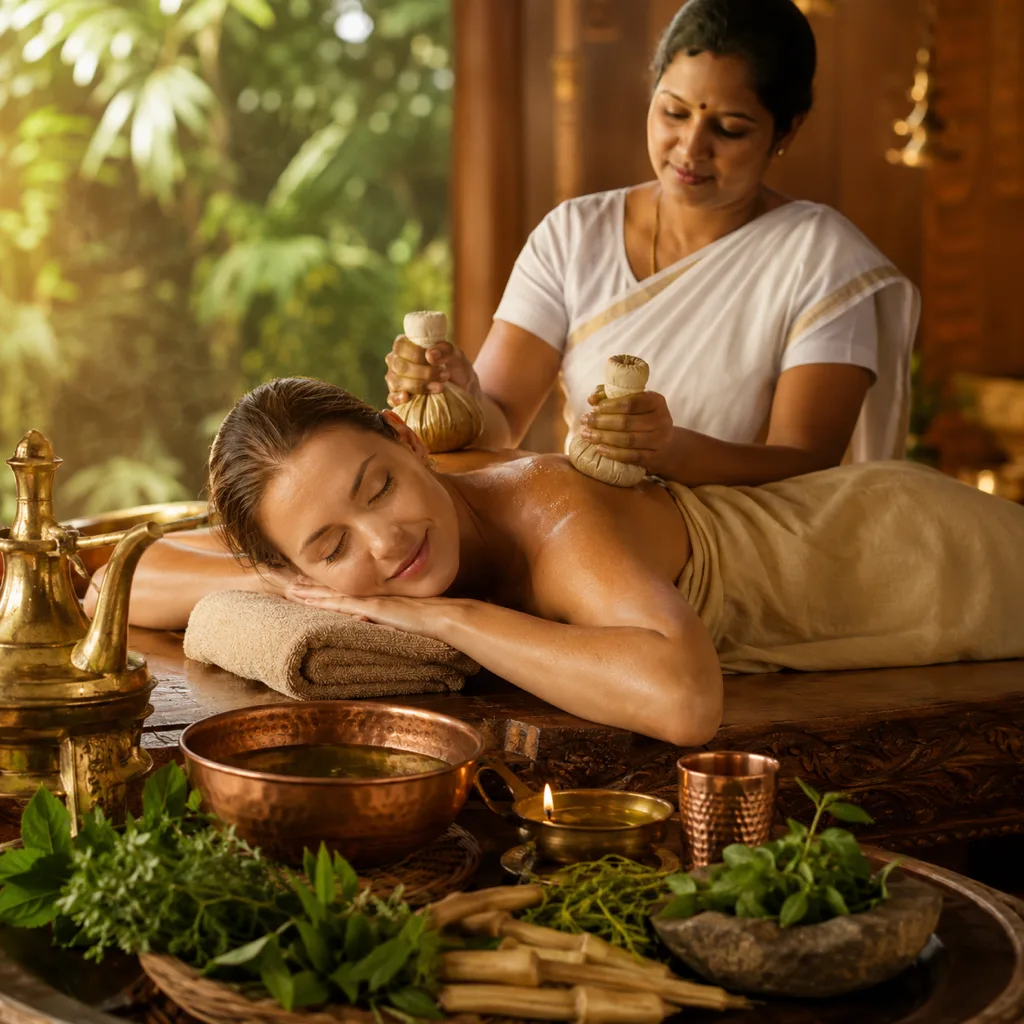
How cleansing goes
Diagnosis
The doctor determines the constitution (doshas), the state of digestion and the agni (the digestive «fire»), then selects an individual programme.
Preparation
Oiling (snehana) and warming (svedana), a light diet — to «soften» the toxins and move them towards the excretory channels.
Cleansing
The cleansing procedures of Panchakarma and the recovery period — all under the doctor’s supervision.
What body cleansing according to Ayurveda is
Ayurveda is a traditional medical system of India in which body cleansing is considered the foundation of health. The logic is simple: when digestion is not working at full strength, undigested remnants accumulate in the tissues — ama (what in everyday language is called «waste and toxins»). Ama disrupts the balance of the doshas and interferes with the normal working of the organs. Therefore body cleansing according to Ayurveda is aimed not at an isolated symptom but at restoring digestion, metabolism and the working of the excretory systems. This is how the removal of toxins according to Ayurveda works — what today is called detox, or detoxification: not the suppression of a symptom, but the elimination of its cause. In the tradition there are various Ayurvedic cleanses — from gentle home practices to deep Panchakarma.
Ayurvedic cleansing comes at two levels: soft — supporting methods, some of which are available at home, and deep — a Panchakarma programme at a clinic under a doctor’s supervision. Which option suits you specifically is determined after diagnosis: there is no universal protocol in Ayurveda.
Ayurvedic clinics where you can undergo body cleansing




Gentle and deep cleansing: what is the difference
Ayurveda for cleansing the body uses two levels of action:
- Gentle (supporting) cleansing — adjustment of nutrition, warm water, spices, light seasonal practices. Suitable for prevention and maintaining tone, partly feasible at home.
- Deep cleansing (Panchakarma) — a complex of therapeutic procedures at a clinic with preparation, a main stage and recovery. Carried out only when indicated and under a doctor’s supervision.
Cleansing according to Ayurveda is always a sequence: preparation, the cleansing itself and recovery. The stages must not be skipped — that is precisely why deep cleansing is undergone at a clinic, and not as a «weekend course».
Cleansing of the intestines and gastrointestinal tract according to Ayurveda
The intestine in Ayurveda is one of the key organs: it is here that ama most often accumulates and from here that imbalance begins. Therefore Ayurveda for the gastrointestinal tract and the intestines gives special attention to cleansing.
- Basti — a therapeutic enema with herbal decoctions or oils. The main method of deep cleansing of the lower intestine; helps to balance vata. Carried out at a clinic.
- Gentle support at home — a sufficient amount of warm water, fibre, spices (ginger, turmeric), a regular eating routine. This does not replace Panchakarma but supports the working of the intestines between courses.
Intestinal cleansing according to Ayurveda is always selected individually and agreed with a doctor — every method has contraindications.
Panchakarma — a programme of deep cleansing
Panchakarma (from Sanskrit — «five actions») is the deepest form of cleansing in Ayurveda: a course of five cleansing procedures at a clinic, under a doctor’s supervision and strictly when indicated. Each procedure cleanses its own «channel»:
- Vamana — removal of excess kapha and mucus (the upper tract, the stomach);
- Virechana — cleansing through the gastrointestinal tract, the liver and the blood (pitta);
- Basti — cleansing of the intestines, balancing vata;
- Nasya — cleansing of the area of the head and nose;
- Bloodletting — cleansing of the blood (strictly when indicated).
More about the procedures and stages is in the section Panchakarma procedures, Virechana, Basti.
Liver cleansing according to Ayurveda
The liver in Ayurveda is connected with the pitta dosha and is responsible for processing and metabolism. When its working is disrupted, ama accumulates and digestion as a whole suffers. Gentle liver cleansing in Ayurveda is built above all on nutrition and herbs with a bitter and astringent taste that support bile secretion — without aggressive «cleanses» and tubages.
Deeper liver cleansing takes place as part of Panchakarma (above all virechana) and only under a doctor’s supervision: the composition of the preparations and the duration are chosen individually, taking contraindications into account.
Liver cleansing is prevention and support; if it is a matter of a specific illness, see liver treatment.
Diet and preparation for cleansing
Any cleansing — both Panchakarma at a clinic and a gentle cleanse at home — begins with nutrition. There is no need to fast: eating remains regular, only the set of dishes changes. Warm, simple, freshly cooked food is recommended — grains, vegetables, leafy greens, spices. For the duration of the course, alcohol, meat, sugar, caffeine, convenience foods and heavy dairy products are usually excluded.
A special role is played by Khichari — a traditional dish of basmati rice, mung beans, clarified butter Ghee and spices. It is light for digestion and nourishing, and the ghee helps to bind and remove fat-soluble toxins. At the preparation stage the ghee is also taken separately — this is part of the oiling of the tissues before cleansing.
Cleansing of the blood vessels according to Ayurveda
In Ayurveda the «clogging» of the blood vessels is associated with the accumulation of ama (toxins) and an imbalance of the kapha and pitta doshas — this disrupts circulation and metabolism. The approach to cleansing the vessels is gentle and systemic: adjustment of nutrition (less heavy, fatty and sweet food), herbs and spices that support fat metabolism and circulation, and the general cleansing procedures of Panchakarma — above all Faced (cleansing through the gastrointestinal tract and the blood), and when indicated — raktamokshana (cleansing of the blood). The composition and duration are chosen by the doctor individually, taking contraindications into account, so full cleansing of the vessels is undergone at a clinic under supervision, and not by «folk» methods.
Cleansing according to Ayurveda for women
The principles of cleansing for women are the same, but there are nuances of timing and contraindications. No cleansing procedures are carried out during pregnancy, breastfeeding or menstruation. At other times, women are more often recommended gentle, sparing programmes with an emphasis on nutrition, the restoration of digestion and the balance of the doshas. The specific programme and its timing are chosen by the doctor after diagnosis.
Can cleansing be done at home
Partly — yes, but this is only about gentle supporting methods, and not about Panchakarma.
What it is sensible to do at home:
- drink enough warm water and establish an eating routine;
- add spices that improve digestion (ginger, turmeric, fennel);
- keep to light, warm, fresh food;
- lighten the diet seasonally (spring — autumn).
What must not be done at home:
- undergo a full course of Panchakarma without a doctor;
- use strong laxatives and castor oil on your own;
- cleanse during pregnancy, breastfeeding, in acute conditions and with a number of chronic illnesses.
Even seemingly harmless herbs have contraindications and may not combine with medicines. Therefore deep cleansing is undergone at a clinic, and home methods are agreed with a doctor.
Why body cleansing is undergone in India
In India, Ayurveda is an official medical system with state standards and the accreditation of clinics. Body cleansing in India takes place with an in-patient stay: a daily routine, nutrition, daily procedures and the doctor’s supervision at all stages — from preparation to recovery. The warm climate and a full course (from two weeks and longer) give what cannot be obtained from short home practices. Panchakarma programmes are carried out under the supervision of experienced doctors; at many clinics the practice is passed down within the family from generation to generation.
Frequently asked questions
The minimum is about two weeks; for a lasting result 3–4 weeks and more is better. The exact duration is determined by the doctor after diagnosis.
Deep cleansing (Panchakarma) is usually undergone once a year — this is enough to maintain balance. Gentle seasonal programmes and adjustments to nutrition can be repeated more often. The exact frequency for your condition will be determined by the doctor.
Classically, cleansing is timed to the change of seasons — these are natural points of the body’s reorganisation. The specific time is chosen individually, taking into account your condition and the season in India. We will suggest the best period.
For pregnant and breastfeeding women, during menstruation, in acute conditions and with a number of chronic illnesses. The decision is made by the doctor at the consultation.
It depends on the clinic, the duration and the level of accommodation — we calculate it individually on request.
We will find a cleansing programme and a clinic to match your condition
Tell us about your goals — we will find a clinic and a cleansing programme to match your condition, duration and budget. The course takes place under the supervision of Ayurvedic doctors, with diagnosis, preparation and recovery.