Virechana — an Ayurvedic procedure for cleansing the body
Virechana is one of the five main cleansing procedures (karmas) of Ayurvedic Panchakarma. It is a targeted cleansing of the lower parts of the gastrointestinal tract with the help of laxatives of plant origin. In Ayurveda virechana is classed among the methods that balance Pitta dosha.

An important caveat right away: Ayurveda is a traditional wellness system. Virechana does not replace the treatment of specific illnesses; in chronic conditions it is undergone as a supplement and only after consulting a doctor.
What virechana is
Panchakarma includes five cleansing actions, and each works with «its own» area of the body:
- vamana — therapeutic vomiting (upper gastrointestinal tract);
- Bast — a therapeutic enema (large intestine);
- virechana — cleansing with laxatives (small intestine, liver, gallbladder);
- nasya — introduction of formulations through the nose (head area);
- raktamokshana — cleansing of the blood.
Basti acts only on the large intestine; the sections located higher up remain outside its influence. Virechana, on the other hand, is directed at the small intestine, the liver and the biliary tract — which is why in Ayurveda it is considered the main method for disorders of the pitta dosha.
Physically the procedure is a controlled purgation. The patient takes an individually selected composition based on medicinal plants — triphala, avipattikar churna, aloe, castor oil with herbs (sometimes in the form of gulika tablets) — after which a natural emptying of the intestines occurs in several acts.
The composition and dose are selected to suit the person’s constitution and condition: with sensitive digestion gentle agents are needed, with a tendency to constipation — stronger ones. Hundreds of recipes are described in the Ayurvedic texts, and only a qualified specialist can correctly choose a suitable one — independent selection is not safe.
How virechana acts on the body
The small intestine is the longest section of the digestive tract: here nutrients and most medicines are absorbed and digestive enzymes are produced. According to Ayurvedic ideas, with weak digestion part of the food is not fully assimilated and forms amu — undigested remnants that can accumulate in the tissues. With the accumulation of ama the Ayurvedic tradition associates heaviness, reduced vitality, worsening of digestion and of the work of the liver.
In this logic virechana is needed — to remove the ama from the gastrointestinal tract and help digestion to recover. It is important to understand that this is an idea of Ayurveda, not a proven medical mechanism, so the procedure is carried out by indication and under a doctor’s supervision.
How virechana differs from an ordinary laxative
Ordinary diarrhoea is a protective reaction: this is how the body rids itself of what it has deemed dangerous (with poisoning, infection, a malfunction of the gastrointestinal tract). It is uncontrollable and exhausting in itself: along with the fluid, electrolytes and trace elements are lost, and with a prolonged course dehydration and mineral deficiency are possible.
Virechana is arranged differently. It is a managed purgation induced by an individually selected herbal composition after special preparation. The procedure is carried out in a metered way: as soon as the required effect is achieved, the purgation is stopped, and within a couple of days the residual phenomena come to nothing. The key difference is not «as strongly as possible» but control: the correct composition, a precisely calculated dose and the accompaniment of a specialist. That is exactly why Ayurveda does not endorse independent experiments with laxatives «by analogy» with virechana.
Indications and contraindications
From the point of view of Ayurveda, virechana balances Pitta dosha and is traditionally applied in pitta-type conditions:
- skin diseases (psoriasis, eczema, acne, dermatitis, urticaria);
- disorders of the function of the liver and gallbladder;
- hyperacidic conditions — increased acidity, ulcer disease;
- chronic migraine and headaches;
- gout;
- some types of diabetes.
This is not a guarantee of result and not a replacement for treatment: in chronic diseases virechana is undergone as a supplement, by indication and under a doctor’s supervision. About the place of virechana among the other cleansing procedures — on the page Panchakarma procedures.
Contraindications. Virechana is not carried out during pregnancy, in childhood and old age, with traces of blood in the stool, exhaustion, dehydration and a high temperature. The procedure is also contraindicated with weak digestion, ulcerative colitis and Crohn’s disease, fistulas and oncological diseases of the rectum — regardless of age and general condition.
Which compositions are used for virechana
There is no single «laxative for virechana» — the composition is selected to suit the person and the task. Most often the following are used:
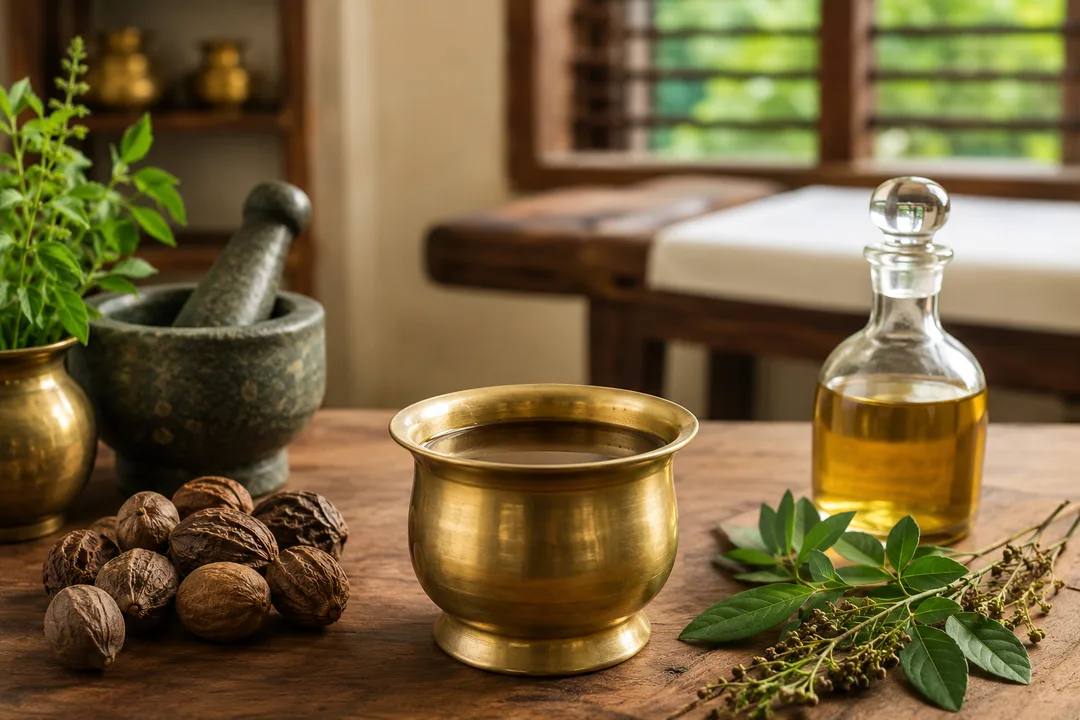
- triphala — a gentle complex of three fruits (amalaki, bibhitaki, haritaki); acts delicately, suits sensitive digestion;
- avipattikar churna — a herbal powder that is traditionally applied with excess pitta and increased acidity;
- castor oil with herbs — an agent more pronounced in action, it is often taken as the basis of the composition for the procedure itself;
- aloe and other plant components — as auxiliary ones.
The compositions are produced both in the form of decoctions and in the form of tablets (Gulika). The strength of the agent and the dose are the doctor’s area of responsibility: too gentle a composition will not give a result, too strong a one threatens dehydration, so selection «by eye» is inadmissible.
Preparation for virechana
So that the procedure goes gently, it is preceded by preparation — Snow white, that is, oiling.
- Internal oiling (snehapana): taking clarified ghee butter with herbs, usually in the morning on an empty stomach, in gradually increasing doses over several days. According to Ayurvedic ideas, the oil helps to soften the ama and separate it from the intestinal walls, in order then to remove it with laxatives.
- External oiling: oil massage and warm procedures. In an Ayurvedic clinic the preparation is carried out under a doctor’s supervision — this is safer than at home.
The doses and composition are determined by a specialist; for the virechana itself, compositions based on castor oil with Ayurvedic additives are more often used. Traditionally the procedure is planned for the waning moon, but the determining factor always remains the patient’s condition, not the calendar.
How virechana goes and whether it can be done at home
Virechana is carried out in the morning, on an empty stomach — when the preparation is completed and the person has slept well the night before. At the time appointed by the doctor (as a rule, early in the morning) the patient takes the laxative composition — for example, castor oil with herbs or another selected preparation — and washes it down with warm water.
Next a key role is played by warm water: it is drunk in small portions throughout the whole procedure, in the intervals between urges — this helps the cleansing to go gently. The emptying happens in several rounds (in Sanskrit — «vega»); the doctor takes their number into account, assessing the completeness of the cleansing: approximately from 10 with a gentle action to 20–30 with a pronounced one. A sign that the procedure is coming to an end is when the exiting content becomes watery and light, without an admixture of faecal matter. After this the drinking of water is stopped, the body rests, and with this the procedure is completed.
The whole day rest and maximally light food are indicated (see below). In the clinic the doctor monitors the patient’s condition — pulse, blood pressure, well-being; possible light spasms or discomfort usually pass by themselves.
Sometimes people try to do virechana at home, but it is important to understand: this is a medical procedure, not an everyday «cleanse». Without preparation and a composition selected by a doctor it is dangerous — an excessive dose or too strong an agent threaten dehydration and loss of electrolytes, and a weak one simply will not give a result. Therefore virechana, and all the more so a full course, is undergone in a specialised clinic under the supervision of a vaidya.
Diet and regimen after the procedure
For a few days after virechana a sparing regimen is kept:
- eat only after the cleansing has completely settled;
- the first food — warm rice broth; then over several days the diet is gradually made more complex: liquid unsalted rice porridge on water, light soups and then ordinary food;
- avoid cold food and drinks, raw vegetables and fruit, a cool shower and chilling;
- give preference to light, freshly cooked warm food and rest.
Such a smooth exit from the procedure (in Ayurveda it is called samsarjana krama) helps digestion to recover without strain.
Conclusion
Virechana is a traditional Ayurvedic procedure for cleansing the small intestine, the liver and the biliary tract with the help of plant laxatives. Its particularity is the individual approach: both the composition and the dose are selected to suit the specific person, and the procedure itself is carried out under a specialist’s supervision. Virechana does not replace treatment and is not a «cleanse from toxins» in the everyday sense — it is a method of Ayurveda with its own indications and contraindications, and one should approach it consciously and together with a doctor.
Virechana can be done at the following clinics of India





Frequently asked questions
With correct preparation (oiling, diet) virechana is tolerated gently — it is not an abrupt «cleansing» but a controlled process under a doctor’s supervision. A specialist tracks the reaction and adjusts the composition and dose.
Virechana is a course procedure, it is not done often «for prevention»: usually it is part of Panchakarma, seasonally, by a doctor’s prescription after a diagnosis.
The procedure itself is one day, but it is necessarily preceded by preparation (oiling and diet, several days) and recovery afterwards. Therefore virechana is undergone within a course, not once off.
Virechana is cleansing through a gentle purgation (works with the pitta dosha). Basti is a therapeutic enema (works with the vata dosha). In classical Panchakarma they are often combined, and the doctor selects the set.
Ready to try virechana in practice? We will select a clinic and a programme to suit your task.