
Oiling of the body, head, organism and joints according to Ayurveda
In Ayurveda, oiling is called Snow white (Sanskrit. Sneha — «oil», «softness»). A distinction is made between internal and external oiling. With the internal one (snowfall) clarified ghee butter is taken internally — pure or with Ayurvedic additives, according to the state of health. External is the application of warm oil to the whole body, «from crown to heel»; such an oil massage is called Abhyanga. Both practices are part of the preparatory complex before the seasonal cleansing of the body — Panchakarma.
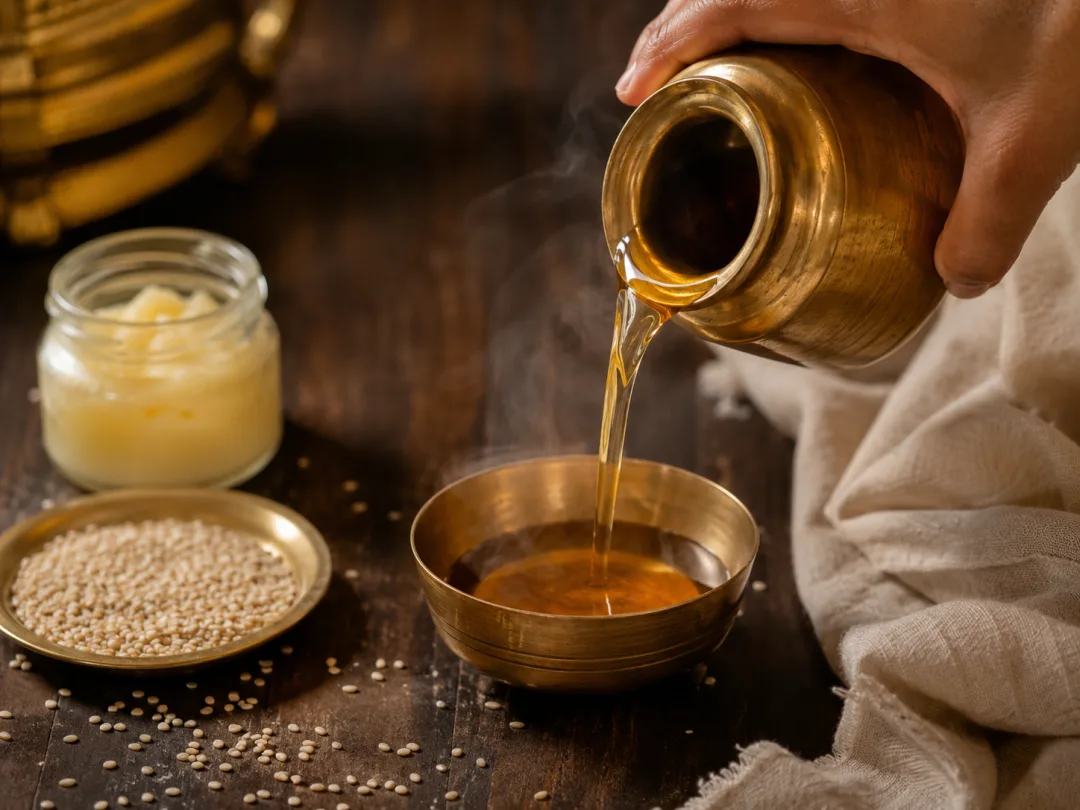
How oiling acts on the body and joints
According to Ayurvedic ideas, warm oil nourishes not only the skin but also the deeper tissues of the body — muscles, joints, ligaments. It is held that with regular application the oil day by day «soaks into» ever deeper layers, which is why oiling is traditionally carried out as a course — about two weeks, not once off. This is the traditional model, and in practice a course of warm oil procedures helps to relax the muscles, soften the skin and relieve the feeling of dryness and tension.
External oiling is safe to do at home too, if simple rules are observed (about them — below).
Which oil to choose for oiling
A special «Ayurvedic» oil is not obligatory. Traditionally, cold-pressed unrefined oils without fragrances or additives are preferred; refined ones are not suitable. A simple rule: if the smell of the oil is pleasant to a person, it most likely suits them.
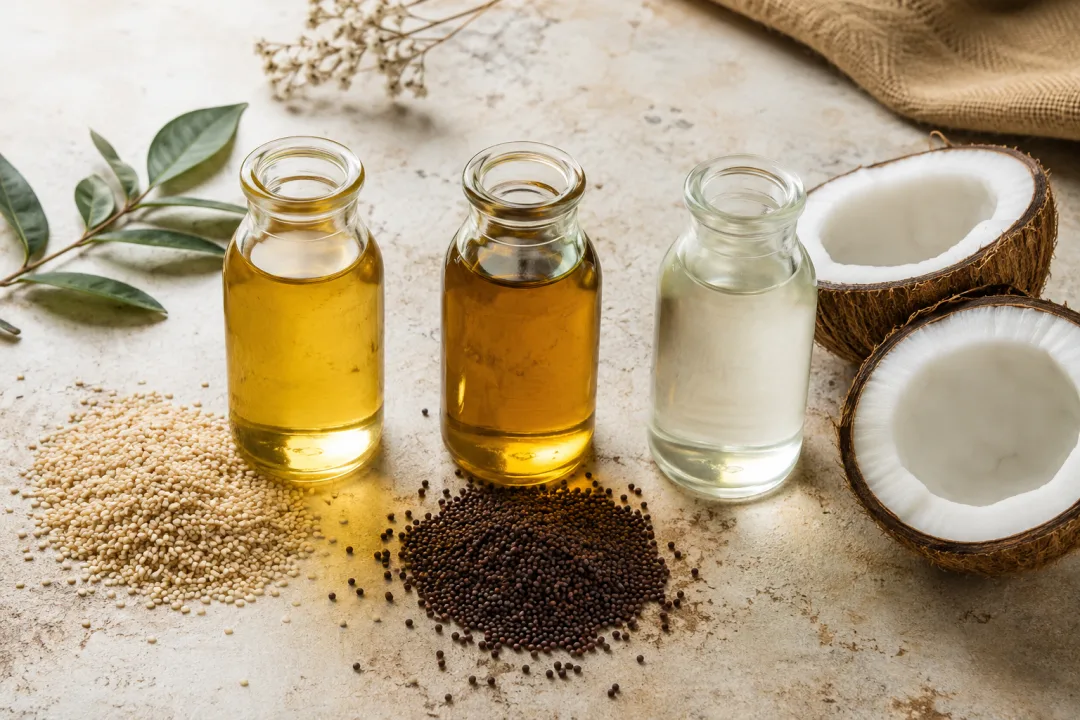
The choice of oil depends on the season and the condition:
- sesame, almond and mustard — warm (mustard is traditionally taken in winter and with excess kapha);
- coconut and olive — cool (summer, with overheating, pitta);
- sunflower and grapeseed — moisturise;
- for very dry skin and for the joints a little castor oil is sometimes added to the oil;
- in general any quality first-pressed food oil will do.
Most often for oiling in Ayurveda one takes sesame oil: it is considered universal, warms well, nourishes the skin and balances all three doshas, especially vata. In clinics, when preparing for Panchakarma compositions with herbs are prepared on the basis of vegetable oils, selected to suit the specific person. At home, compositions with essential (aromatic) oils or Ayurvedic preparations should not be used without the appropriate knowledge.
Oiling of the head and hair
Warm oil on the scalp cares for the hair, and the massage itself relaxes the muscles, relieves tension and improves local blood circulation.
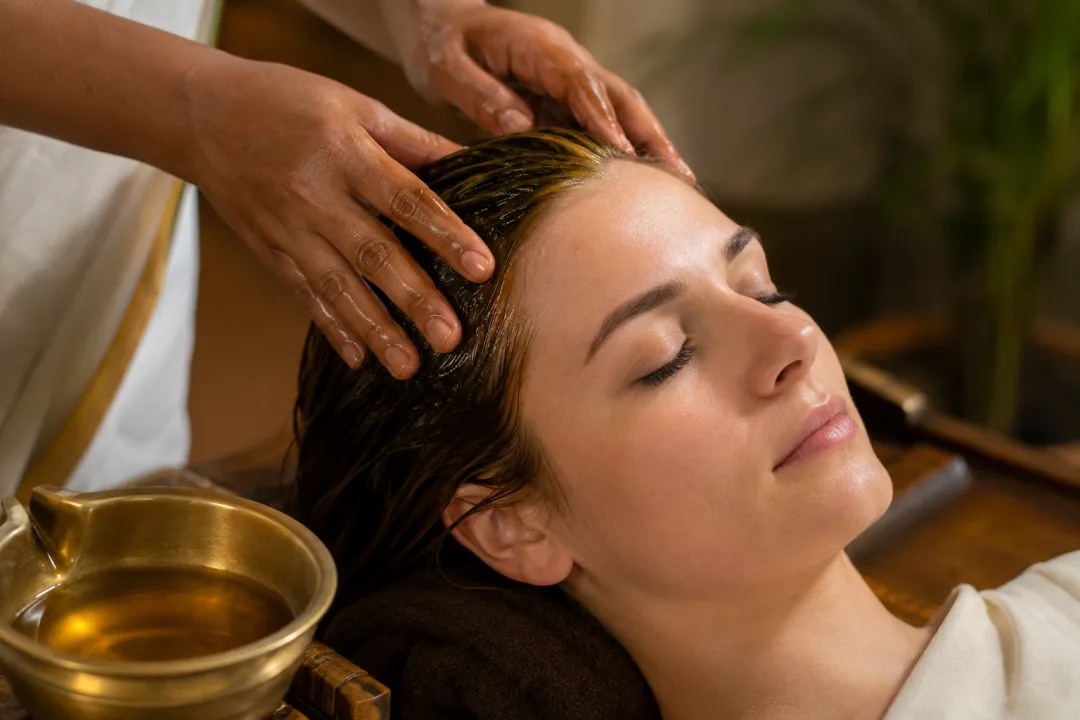
Slightly warmed oil is applied with gentle circular movements to the scalp, face, neck and ears. After about an hour it is washed off: first a mild shampoo is spread over the hair without water, then warm water is added little by little and rinsed off — two or three cycles may be needed. If time is short, a shortened variant is done: oil only on the temples and the point at the base of the neck — then the whole head does not have to be washed.
Oiling of the navel (nabhi)
In Ayurveda the navel (navel) is considered one of the important centres of the body, connected with digestion and, according to traditional ideas, with a network of energy channels (nadi). A separate practice is devoted to its care — nabhi purana («filling the navel» with oil).
It is done simply: in the evening a few drops of warm oil (most often sesame or ghee) are dripped into the navel, gently rubbed around the navel area with circular movements and left for 20–30 minutes or overnight.
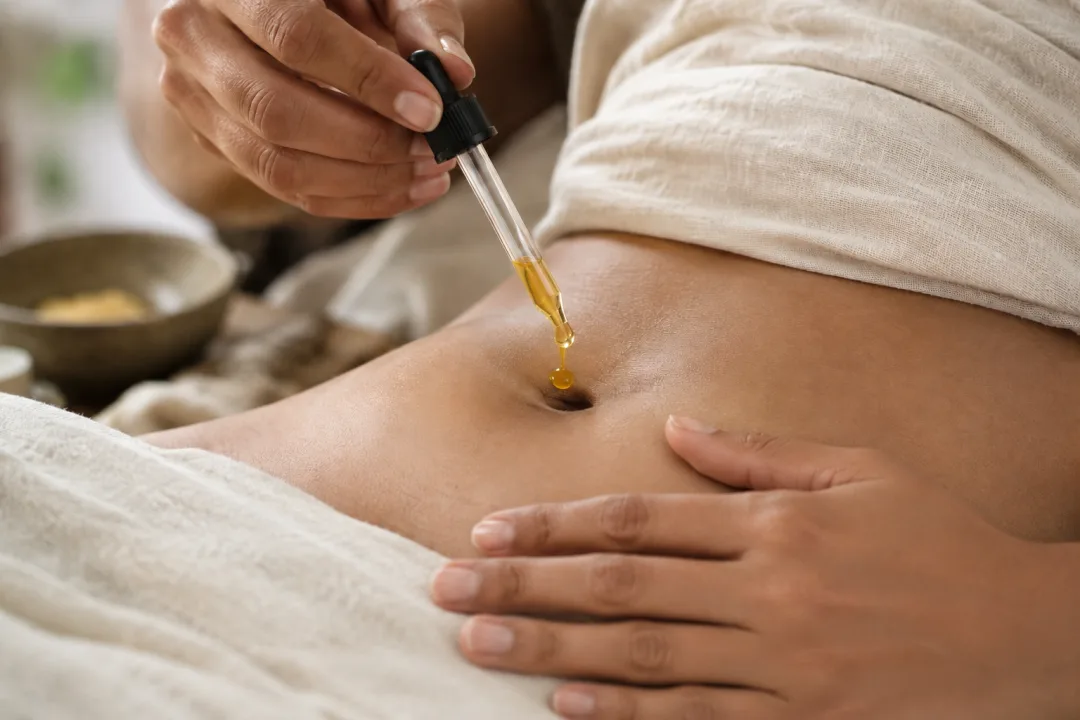
According to Ayurvedic ideas, warm oil in the navel calms vata and is therefore traditionally applied:
- to support digestion — with bloating, heaviness, discomfort in the abdomen;
- for softness and moisturising of the skin (including the lips);
- for relaxation and calm sleep;
- for women — to ease menstrual discomfort.
The practice is gentle and easy to carry out at home. At the same time it is a wellness ritual, not a treatment: with pain and persistent disorders a doctor’s consultation is needed.
Oiling during pregnancy
Ayurveda holds that it is important for an expectant mother to protect the body from dryness. Along with proper nutrition and a calm environment, gentle oiling with a base oil is recommended — without aromatic (essential) additives and only after consulting a doctor. Essential oils during pregnancy may be unsafe, especially in the first trimester. It is better to do the oiling in the morning, 5–10 minutes; oil on the head — no more than twice a week. The composition is selected by the doctor taking into account the woman’s constitution; in the absence of knowledge a simple food oil without fragrances is taken. A full Panchakarma is not carried out during pregnancy.
How to do body oiling at home (step by step)
At home body oiling is more convenient to do in the evening: after the procedure you want to rest or go to bed, and there is no need to hurry. A warm, secluded place is needed — usually the bathroom.
- Warm the oil to pleasantly warm. Pour it into a glass or plastic container and place it in a larger bowl with hot water. There is no need to measure the exact amount.
- Apply from the bottom upwards. Start with the feet, move up the shins and thighs; the arms — from the hands to the shoulders. On the long areas (arms, legs) — long movements, on the joints — circular ones. Give more attention to the problem zones — the joints, ligaments.
- Let the oil soak in and sweat a little. Leave the oil on the body for 20–30 minutes (up to an hour is fine). During this time stay in the warmth and move a little — light exercise, stretching or a warm shower help the body to warm up and sweat slightly. In Ayurveda this stage is called information (a light sweating after oiling): it helps the oil to «work» and makes washing off easier.
- Wash off with warm water (how — in the next section).
Tip: spread a towel or a dense cloth on the floor in advance so as not to slip, and prepare rags/paper towels — the hands and surfaces will be oily.
How to wash off the oil
Warm oil is washed off with warm (can be hot) water. Traditionally in Ayurveda, instead of soap, one uses ubtan — a powder from gluten-free flour (chickpea, almond, corn) or finely ground oats; sometimes with the addition of cosmetic clay. Ubtan gently «rolls» the oil off the skin without over-drying it: stand under warm water and apply the powder to the body with light circular movements. So that the remnants of oil and flour do not clog the drain, cover the drain hole with a mesh and put a non-slip mat on the bottom.
At home you can do it more simply: wash off the oil with warm water and a mild shower gel. Ubtan is a more careful traditional way, but not the only possible one; choose according to convenience.
Conclusion
Oiling (snehana) is one of the preparatory stages of Panchakarma and an independent wellness practice. Warm oil softens the skin, nourishes the tissues and helps to relax. It is not necessary to time it to Panchakarma — a gentle self-massage can be practised at home too. Oiling also includes Shirodhara — warm oil that is poured in a stream onto the forehead.
Oiling is a wellness practice of Ayurveda, not a replacement for treatment; with illnesses undergo it only after consulting a doctor. A full course under the supervision of specialists can be undergone at clinics of India — select a tour.
Indian clinics where professional oiling is carried out





Traditionally cold-pressed unrefined oil without additives is taken; the most frequent is sesame (warms). In summer or in the heat coconut (cools) will do. A special Ayurvedic oil is not obligatory. Gentle home oiling can be done regularly, up to daily, if it brings comfort. Course and intensive programmes (especially within Panchakarma) are carried out under a specialist’s supervision. The navel (nabhi) in Ayurveda is associated with digestion, so warm oil in the navel is traditionally applied for bloating and discomfort in the abdomen, for softness of the skin, relaxation and calm sleep, and for women — for menstrual discomfort. Snehana is the whole practice of oiling (of the body, head, navel, internal — ghee). Abhyanga is its particular type: an oil massage of the body performed by a therapist or by yourself. Yes, external oiling of the body and head is safe to do at home with a base food oil. Compositions with essential oils and Ayurvedic preparations — only with a specialist. It is not done with a cold and increased mucus (kapha), with disturbed digestion and a feeling of heaviness (in Ayurveda — a sign of ama), with acute conditions and a high temperature. With chronic illnesses and pregnancy — only after consulting a doctor.
Frequently asked questions
Ready to try Ayurveda in practice? We will find a clinic and a programme to match your goal.