Indian Ayurvedic massage (abhyanga): what it is, its types and benefit
In India massage is an integral part not only of the healing process but of ordinary life. There are everyday rituals that include one or another rubbing movement. The main principle of Ayurveda is to regard the person as a single whole. Healers never treat one separate organ, they assess the work of all the systems and find the roots of the problem. Ayurvedic massage works with the body and the biologically active points (marmas).
Features of Ayurvedic massage
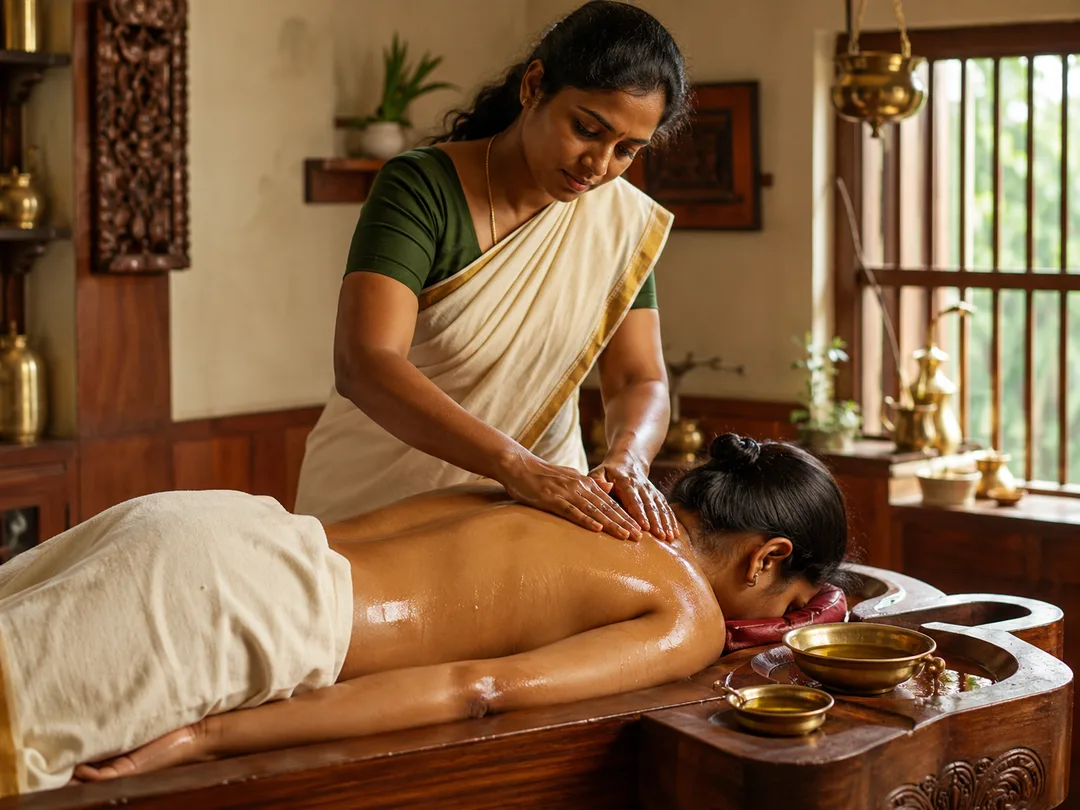
Indian Ayurvedic massage is not just relaxation, it is to a greater extent a therapeutic procedure. It is carried out either on the whole body or on separate parts of it. There are special procedures only for the feet or the head, sometimes exclusively the area of the spine or the abdomen is worked on. Everything depends on the aim. An Ayurvedic doctor will help to choose one or another procedure after an examination and determining the problem.
Women value Ayurveda for the possibility of relieving tension, improving well-being and the condition of the skin and hair. Men are drawn by the relaxing side, the working-through of deep muscles and the wellness. There are no special differences between women’s and men’s massages except, perhaps, the strength of the pressure.
The massage courses familiar to us take several months and give only a general notion of this art. In India Ayurvedic doctors study the principles and techniques of massage over 6 years, at the same time obtaining a higher medical education.
Advantages and disadvantages
The main plus of a correct Ayurvedic massage is the wellness of the whole organism. During a session not only the muscles are worked on, all the organs and systems are involved in the work, including the psychological component. A course of procedures helps to restore strength and relieve accumulated tension. Oils, a sparing diet and a regimen (rest, meditation, yoga) help to relax and improve well-being.
After sessions discomfort sometimes arises, but it is hard to call it a disadvantage. It is a sign that the organism has joined in the work and is reacting appropriately. As a result of the sessions blood circulation improves. Redness and skin rashes, diarrhoea are possible. If this does not cause great inconvenience, then there is no need to worry — the organism is simply reacting to the effect.
Usually during the work the specialists use a great deal of oil. After a session it is necessary to take a shower and, possibly, wash the hair. That is, the whole procedure, including the necessary rest and washing, will take a lot of time.
Some variants of Ayurvedic massage give a result almost immediately. The skin tightens, the contours of the figure become clearer, the hair looks well-groomed and shiny. But there are therapeutic procedures whose action unfolds gradually. For example, the effect of point massage does not appear at once but lasts several months.
Indications and contraindications for carrying out Ayurvedic massage
Massages of all kinds are prohibited during pregnancy and during a woman’s critical days. Besides this, there are several diseases in which sessions must not be undergone:
- all colds or infectious diseases (the organism is weakened and may not withstand the extra load);
- Oncology;
- allergy to oils and medicinal plants;
- skin problems in an acute form;
- digestive disturbance;
- fever, high temperature.
Ayurvedic massage performed by a specialist helps to:
- relieve stress;
- restore inner balance;
- improve the work of the blood vessels and the lymphatic system;
- get rid of insomnia and headaches;
- normalise blood pressure;
- work on the spine and the joints.
Clinics in India include massage in general restorative and wellness programmes. However, one must not make the decision to undergo a course independently, without consulting a qualified Ayurvedic doctor. It is too effective a procedure.
Rest is an important component of physical and mental health. The oil procedures of Ayurveda give literally every cell of the organism a rest.
Preparation
Traditionally Ayurvedic massage is carried out in the morning or evening hours. The patient should come to the session with an empty stomach, so that the internal organs are not «distracted» by the digestion of food. During the work the master constantly adds new portions of oil, so that the hands glide gently over the skin without causing discomfort. After the session it will be necessary to take a shower and rest for at least fifteen minutes.
During the course a sparing diet is recommended. If possible, one should give up meat dishes, fast food, alcohol and coffee. Fresh fruit, juices, grain products and plenty of clean water are needed. The ideal option is to set aside several free days for a course of Ayurvedic massage without excessive physical and mental strain, or to turn to a specialised clinic.
The technique and rules of doing massage according to Ayurveda
In the rules of Western medicine the massage movements are always directed from the periphery to the centre — from the extremities to the middle of the torso. Traditional Ayurvedic massage allows the reverse direction. Depending on the indications and the aim of the procedure, specialists may start the work from the middle of the abdomen and then move up to the crown or down to the feet.
The master uses different types of movements: circular rubbings, semicircular movements with the fingers, long smooth strokes of the back and abdomen, working of the joints with widely spread fingers. The direction and strength of pressure are selected to suit the aim of the procedure and the person’s condition.
The head is always massaged in a circle starting from the crown. The neck is passed over very carefully with light movements of the whole palm (there are many large blood vessels here). The legs are always kneaded from the groin to the knees and from the knees to the feet. The feet are massaged last.
The areas in the region of the groin and the mammary glands must not be massaged. Working of the collar zone can raise blood pressure. In the region of the heart the pressure is always noticeably weaker.
Types of Ayurvedic massage
Ayurvedic massage (abhyanga) is part of snehana, the preparatory stage of Panchakarma. Indian massage is indicated for any diseases of the joints (arthritis, arthrosis), problems with the internal organs. During the procedure pouches with herbs, cold marble and hot basalt stones, special equipment for oilingare sometimes used. The sessions are accompanied by aromatherapy.
The classic relaxing Abhyanga massage
The name of the classic Indian procedure translates roughly as «to rub the limbs». First oil is applied to the skin of the whole body and allowed to soak in a little. Then with smooth circular movements the areas of the abdomen and chest are worked on; the direction of the movements depends on the aim of the procedure. The arms and legs are kneaded with straight movements.
Abhyanga in Ayurveda is applied for neuromuscular tension, to improve the condition of the skin, subcutaneous tissues and muscles. Two specialists with four hands work simultaneously on the right and left halves of the body, achieving an even flow of blood to all organs and tissues. The advantage of the procedure is that attention is given to literally every centimetre of the skin surface. A correction of the figure takes place, a thorough working of the muscles of the back and spine. Thanks to the stimulation of blood circulation in the region of the neck and head, concentration improves and stresses and fatigue are relieved.
Indian head massage and shirodhara
Indian head massage is part of abhyanga: the scalp, neck and shoulders are gently kneaded with warm oil. The muscles relax, tension in the area of the neck and shoulders goes away, concentration improves, and the skin and hair look well-groomed.
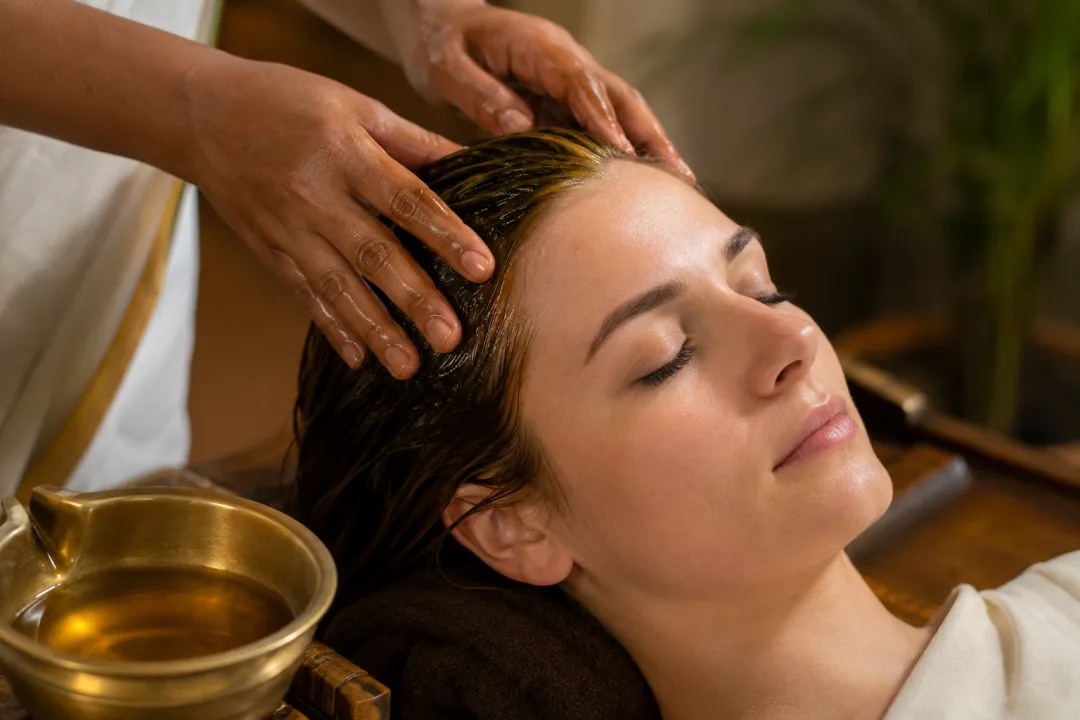
Shirodhara stands apart — it is not a massage but a procedure in which warm oil pours in a thin stream onto the forehead, into the area of the «third eye». More detail — on the page Shirodhara.
Pizhichil — a warm oil bath
Two therapists for 45–60 minutes rhythmically pour warm medicinal oil over the body, at the same time gently massaging it. The procedure relaxes deeply; in Ayurveda it is traditionally applied for stiffness and pain in the back, for the restoration of strength.
Rest for the feet — Padabhyanga
This is one of the types of Indian therapeutic massage. The Ayurvedic specialist works only with the feet, but the action resonates through the whole organism. The reflex or biologically active points (marmas) undergo thorough working, sending signals to all organs and systems. Complex Ayurvedic compositions are used in the work, which may include up to thirty different oils. Padabhyanga relieves fatigue, cures insomnia, but it must not be done with oncological diseases and varicose veins in the last stage.
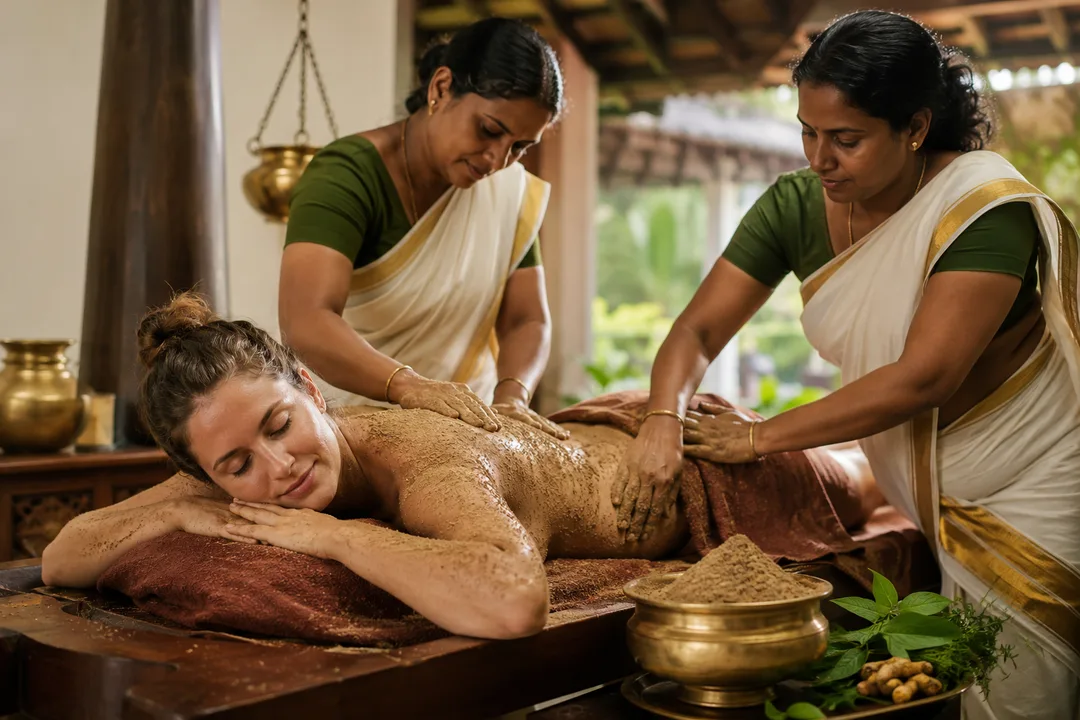
Udvartana — a powder massage against cellulite
Udvartana is a deep massage with dry herbal powders (sometimes with the addition of oil). The powder acts as a gentle peeling, improves blood circulation and the condition of the skin; traditionally udvartana is included in programmes for weight loss and work with the kapha dosha. It does not «burn fat» but helps to improve skin tone and metabolism — most noticeably, volumes go down. It is contraindicated with skin diseases and skin damage.
Point massage — Marma
According to the classical Ayurvedic texts (Sushruta Samhita), 107 marmas are distinguished on the body — special active points where vessels, ligaments, muscles and nerve endings converge. The 108th marma in Ayurveda is considered to be the mind (intellect) itself — the highest «point», governing all the rest. Some of them are located just under the skin, others are buried several centimetres deep. One needs to know the scheme of the location of the marmas very well in order to choose the correct pressure, the sequence of performance and the duration.
According to Ayurveda, marmas are special active points on the body connected with certain organs or tissues. Working on them helps to relieve clamps in the muscles. The work is done in two stages. First the muscles and ligaments are well oiled and kneaded, then the marmas are worked on. The specialist makes small circles with smooth clockwise movements.
Working on the marmas is palpable, but with the correct technique it is done carefully and should not cause severe pain.
Selection of the medicinal oil for Ayurvedic massage
Oils for Ayurveda are chosen in accordance with the patient’s condition and constitution. Usually these are high-quality unrefined oils. Sometimes compositions with the addition of medicinal plants, prepared according to old Ayurvedic recipes, are used.
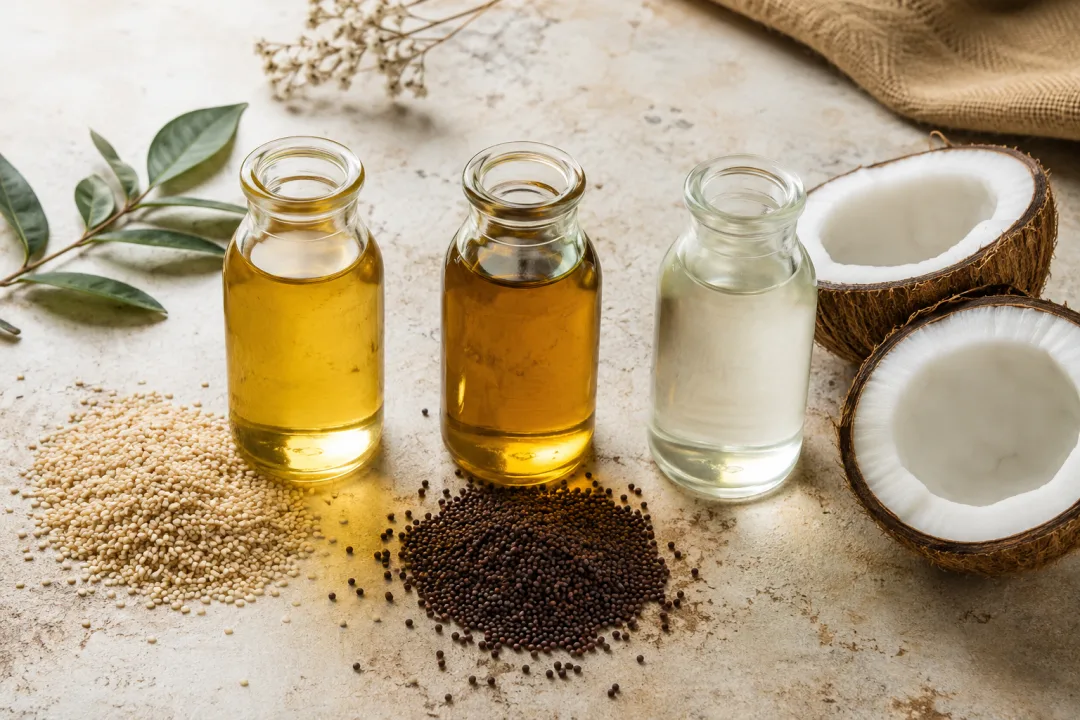
Most often one of the following oils is used:
- sesame;
- Olive;
- mustard;
- Castor;
- Maize;
- Coconut.
Choosing the right Ayurvedic oil mixture is very simple: preference is given to the composition whose aroma is pleasant. If a person cannot bear the smell of the offered agent, they will not be able to relax. The session will not bring the expected benefit.
Self-massage according to Ayurveda — to do or not?
It would seem, what harm can there be from ordinary rubbing? In reality massage affects not only the skin, it acts on the muscles, ligaments, joints and internal organs. Even the simple application of cream to the face needs to be done taking the massage lines into account.
On one’s own one can work on the feet, hands, palms. Light working of the scalp is allowed. But all this needs to be done very carefully. In the feet, palms and on the auricles there are very many active points, an effect on which will have noticeable consequences. If there is a desire to carry out an Indian Ayurveda procedure at home, one will have to obtain at least initial knowledge of the techniques and rules of the work.
Self-massage has a substantial drawback — it is impossible to fully relax. One will have to pay attention to the movements and the strength of pressure. A full Ayurvedic procedure with maximum benefit can only be done by a specialist.
Conclusion
Ayurvedic massage cannot be regarded as a panacea for all diseases. Critical conditions, oncological diseases or advanced inflammatory processes require immediate medical intervention. But Ayurveda is able to prevent these problems, restore the balance of vital forces and strengthen the organism. If one regularly maintains health, relieves stresses and tension, one can catch problems in their embryonic state. Correctly performed Ayurvedic massage is a pledge of a long and healthy life. Ayurvedic massage is a wellness practice, not a replacement for treatment; with illnesses it is undergone only after consulting a doctor.
Ayurvedic massage is part of the preparation for a Panchakarma programme.
Professional Ayurvedic massage can be obtained at the following centres




Frequently asked questions
An ordinary massage works mainly with the muscles. The Ayurvedic one (abhyanga) is done with warm oil selected to suit the constitution, and regards the body, skin and nervous system as a single whole — the task is not only to knead the muscles but to relax, nourish the skin and relieve tension.
A gentle abhyanga can be done regularly, up to daily, if it brings comfort. Course and intensive programmes (especially within Panchakarma) are carried out under a specialist’s supervision.
Usually 45–60 minutes. In the clinic the time and set of movements are selected to suit the aim — relaxation, skin care or preparation for cleansing procedures.
Abhyanga is an oil massage of the body. Shirodhara — warm oil that pours in a stream onto the forehead (it is not a massage). Oiling (snehana) — a broader concept: the whole practice of nourishing the body with oil, which includes abhyanga too. All three are often combined in one course.
Ready to try Ayurvedic massage in practice? We will select a clinic and a programme to suit your task.